






























Product Owner, Carriers & Academy, focused on carrier technology and software adoption.

Content Marketing Specialist with expertise in B2B SaaS, SEO, AEO, and technical writing.

Director of Marketing with 10+ years in B2B SaaS demand generation and revenue growth.
One platform for transport management and supply chain, built on Salesforce.
Book a demoDigital product passports (DPPs) are coming to EU borders.
Starting in 2026, customs will check for them automatically. No valid passport means delays at the border, which is a new variable in clearance workflows.
The DPP is a market access requirement under ESPR. While batteries serve as the blueprint for it, textiles will be the first to fall under the enforcement, followed by construction products and electronics.
The challenge with EU digital product passports is simple: product data, supplier docs, and shipment records rarely live in the same place. Getting them aligned takes time. Companies that start preparation now have more flexibility than those who wait for enforcement to begin.
That's why this article breaks down what DPPs are, when they hit your products, and how to assess your readiness for them before they roll out.
What Is a Digital Product Passport?

A Digital Product Passport (DPP) is a mandatory digital record that tracks a product's materials, origin, environmental impact, and repair instructions for its entire lifecycle, typically 15-20 years.
That data requirement carries weight. Starting in 2026, the EU requires DPPs for batteries, electronics, textiles, and construction materials.
What a DPP Typically Includes
The specific requirements vary by regulation, but here's what you'll typically need:
- Product Identity and Responsible Economic Operator: Who placed this product on the EU market and stays accountable for its data.
- Material Composition and Sustainability Attributes: Specific material percentages and chemical composition data.
- Repair, Reuse, and Recycling Instructions: Repair manuals, disassembly procedures, and material recovery processes.
- Verifiable Credentials: Certifications and conformity data in machine readable format.
What a DPP isn't
- Just a QR Code: The code is an access point. The DPP is the complete data system that responds when scanned.
- A Marketing Label: DPPs serve regulatory compliance and supply chain transparency first.
- A Static PDF: One-time uploads don't meet machine-readability requirements.
Critical Technical EU Requirements for the Digital Product Passport
Beyond the data elements themselves, two technical requirements will determine whether your DPP actually works in practice:
- The Data Must Remain Continuously Available: For long product lifecycles, links cannot break. Hosting must survive company sales and mergers. Data must persist through system upgrades. Access must stay online 24/7 for 15-20+ years.
- The Data Must Be Machine-Readable: Your data needs to be in structured formats that systems can query automatically, such as JSON, XML, or API endpoints. PDFs, Word documents, and spreadsheets won't work.
Why the EU Replaced Paperwork with DPPs
Enforcement has always been difficult: companies self-report, inspectors check samples when possible, and cross-border verification varies widely.
DPPs are the EU's fix.
Instead of reviewing paperwork, the system requires product data in digital formats that computers check automatically. Not occasionally. All the time.
The EU is creating a digital checkpoint for every product. If a product can't pass that checkpoint (with the right data, in the right format, available on demand) it can't enter the market easily.
The cost shifts from paperwork to data preparation. That means:
- Pulling product information from systems
- Converting supplier documents to digital formats
- Tracking changes and updates
- Ensuring data accessibility for years
When a digital passport has issues, operations get delayed. This affects trade compliance, logistics, procurement, customs, and customer service teams.
Which EU Laws Are Driving DPPs

There's no single EU digital product passport law.
You're dealing with five different EU regulations, all requiring overlapping product data. Most companies are waiting for one big compliance deadline. That's not how this works.
Enforcement rolls out in waves, with new requirements issued every 12-18 months.
Think of it like your smartphone. The Ecodesign for Sustainable Products Regulation (ESPR) is the operating system. It sets the rules for how everything works. Delegated acts are the updates that roll out over time, each one switching on new requirements for a specific product category.
Just like iOS updates, you don't get to choose the timing. Apple decides when a feature goes live; the European Commission decides when a product category faces new obligations. Batteries got their update first. Textiles are next. Electronics are queued up behind them.
The difference? Skipping a phone update means the apps might glitch. Not being ready for a delegated act means a company's shipments might not clear customs.
The DPP Enforcement Timeline

Enforcement is rolling out in waves:
- Textiles start in 2026. While the full passport comes later, early rules kick in now. Large companies must report destroyed unsold goods, facing destruction bans by July 2026.
- Battery Passports become mandatory in 2027. This is the first fully digital, scannable passport requirement to go live for an entire category.
- Textiles and metals ramp up through 2027-2028 as the EU publishes the complete data specifications.
- Electronics follow in 2029-2030.
The EU starts with categories where traceability pressure is highest, products with severe environmental impact, visible waste streams, or heavy political scrutiny. Then they expand.
Each product category operates on its own timeline.
Some obligations start before full data specifications are finalized. You're expected to start reporting before you know exactly what format the data needs.
Enforcement arrives as a chain reaction:
- Delegated acts define data requirements
- Companies source and structure data, discovering supplier gaps
- Systems connect: registries, resolvers, access controls
- Customs validates passports during routine checks
- Invalid or missing passports block shipments
The operational shift to watch: enforcement moving from manual spot-checks to automated verification at borders. Data gaps that once resolved with a phone call will trigger system-level holds.
Which Industries and Products Are Affected

So who faces these deadlines? EU digital product passport obligations don't stop at the brand. Instead, they travel through the supply chain. Here's where enforcement pressure will land.
Batteries

Batteries are used as a template for DPPs for all other product categories because they require item-level identity. Not just "this model," but "this specific battery pack." They also require dynamic lifecycle data (state of health, usage history, lifecycle status) plus deep material and carbon disclosures tracing back to raw material sourcing.
Affected industries: EV and mobility OEMs, energy storage providers, electronics companies embedding batteries, manufacturers of e-bikes and e-scooters (LMT batteries), and industrial battery producers for stationary energy systems.
Pressure hits hardest on non-EU exporters, OEM supplier chains, and companies managing battery documentation in PDFs or spreadsheets. So what can you do to prepare? Start by connecting each battery's digital identity to its physical movements, so the passport follows the product, not just the paperwork.
With Neurored TMS & SCM, teams can capture an external battery or product passport ID on the relevant operational records and carry it through logistics events such as pickup, transfer, warehouse receipt, and final handoff, using inventory visibility, warehousing, tracking, and documentation workflows.
The result is operational clarity: you can locate each identified unit and produce an auditable trail without relying on disconnected PDFs or spreadsheets that break traceability.
[cta|Keep Battery Passport IDs Connected to Shipments|See how Neurored links external passport IDs with shipment records, warehouse events, and documentation to support traceability across handoffs.|Book a demo|#contact]
Textiles

Textiles are operationally difficult because of scale: massive SKU counts combined with multi-tier supplier networks create hard-to-close data gaps.
Affected industries include fashion and apparel brands, fast-fashion retailers, luxury goods producers, textile manufacturers across Tier 1 through Tier 4 suppliers, and companies managing inventory destruction.
Early obligations focus on unsold goods disclosure, destruction bans, and proof of diversion to reuse or recycling. Large enterprises face the destruction ban by July 2026.
The solution isn't collecting more documents. It's making sure supplier compliance data is tied to the inbound shipment, so the right paperwork is available when the container arrives.
Systems like Neurored TMS & SCM can help by keeping supplier compliance documents in one place and linking them to the related orders and inbound shipments. That way, teams can check what's missing before arrival and pull the proof directly from the shipment record when needed.
[cta|Keep Supplier Compliance Documents Connected to Shipments|See how Neurored links supplier documents to orders and inbound shipments so your team can identify missing paperwork before arrival and retrieve it when needed.|Book a demo|#contact]
Construction Products

Construction products have lifecycles spanning decades. Data must outlast vendors, systems, and companies. DPPs will integrate with Building Information Modeling (BIM) systems to create a permanent record of every material in a building. A component might need traceability 30-50 years later.
Affected industries: Building material manufacturers, construction firms, architectural product suppliers, infrastructure developers, and companies integrating with Building Information Modeling (BIM) systems.
Why Many Companies Will Be Hit More Than Once
Metals, electronics, and strategic materials cut across multiple product groups. A single company may face battery rules for one product line, textile rules for another, and construction obligations downstream.
Teams building separate systems for each product category will struggle as requirements multiply. Those investing in future-proofing their freight operations build shared infrastructure instead: data pipelines connecting supplier networks, inventory systems, and shipment tracking in one place.
How a Digital Product Passport Works in Practice

Think of a DPP like a library system: the product is the book, the passport is the catalog record, the scan code is the barcode that points you to it.
When someone scans a product, they trigger a lookup. The scan points to a registry. The registry routes to the data host. The data host returns only the information that a person is allowed to see.
What comes back depends on who's asking. Access is role-based and verifiable.
Not all DPP data is public:
- Consumers see care, repair, recycling guidance
- Customs sees whether the passport exists and is valid
- Regulators see full technical and compliance files
- Recyclers and repairers see disassembly instructions, hazards, parts identifiers
- B2B partners see provenance and specifications
Even as the EU clarifies exactly who sees what, you need the underlying capability now. You need role-based access controls, verifiable proofs, and reliable hosting that persists over long lifecycles.
Two requirements matter most:
- Data must be structured and machine-readable (PDFs don't work)
- The link between product and passport must stay live over long lifecycles
For companies managing international shipments, this creates a new operational requirement: keeping the digital identity attached to physical goods throughout execution.
That means linking DPP identifiers to transport documents like Bills of Lading or customs declarations, a task made easier with integrated shipping document management. This way the passport follows the product through every checkpoint. This is where a multimodal TMS becomes practical infrastructure.
In Neurored TMS & SCM, you can capture external identifiers (such as serial numbers) on shipment and inventory records, and associate them with the transport and customs documents and warehouse events tied to that movement.
The point is simple: the identifier travels with the shipment record, so the passport link does not get lost when the product changes hands, crosses borders, or moves through warehouses.
[cta|Keep Product IDs Connected Across Logistics Handoffs|See how Neurored links external product identifiers to shipment records, transport documents, and warehouse events to help preserve traceability as goods move.|Book a demo|#contact]
How the EU Will Enforce DPPs at the Border
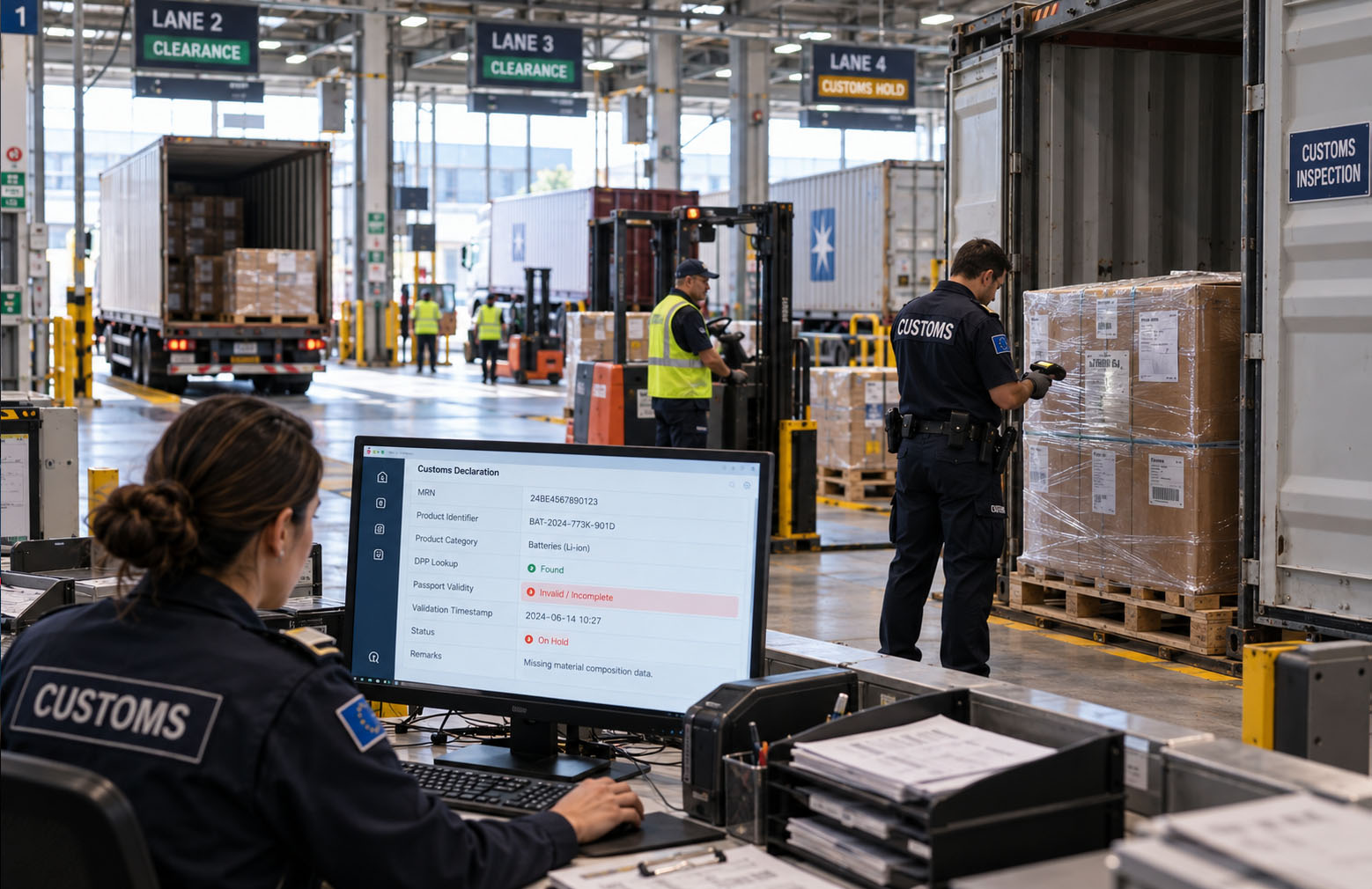
As customs systems connect to DPP registries (via the EU Single Window and CERTEX), validation becomes part of routine clearance.
The customs declaration will include the relevant identifier, and the system will check whether a passport exists and is valid.
Automated validation changes how exceptions get handled.
Today, a documentation issue might be resolved with an urgent email. In an automated system, validation happens at entry. If the check fails, goods don't move until fixed.
For operators, 'blocked' means containers waiting, fees piling up, missed windows, and escalations across multiple teams.
Non-EU exporters face the same requirements.
The regulation applies to any product entering the EU market, regardless of where the company is based.
For teams managing international shipments, this creates a need to spot problems early. Tracking customs status in real time and linking it to specific products helps teams respond quickly when validation issues arise.
Digital Product Passport Readiness Checklist

You should treat DPPs as an operational system. Use this checklist to assess where you stand.
Data: Can You Find the Required Information?
- Can you pull data from ERP, PLM, or supplier systems, or is it scattered across PDFs and email threads?
- Is it machine-readable and consistent, or does it need manual cleanup?
- How far back does visibility go, just Tier 1 suppliers, or deeper?
Here's what you can test: If an auditor asked for proof tomorrow, would you send a structured record or dig through files?
IDs: Can You Track Products Reliably?
- Do you have identifiers at the right level (model, batch, item)?
- Can IDs survive handoffs across logistics providers, resellers, and recyclers?
- Are they aligned across product records, shipping documents, and customs declarations?
If product IDs and shipping IDs don't map cleanly, you create gaps in the chain of custody.
Systems: Can You Store and Share the Data?
- Can you host passport information reliably so links don't break?
- Can you support different access levels?
- Can you store verifiable proofs for key claims?
A note for shipment managers: connect passport references and compliance proofs directly to shipment records. When verification happens at the border, you need data in context, not buried in email threads or scattered across folders.
This is where the Neurored Supply Chain Control Tower Software helps in practice. You can attach compliance documents and key references to the shipment record, and use exception alerts and discrepancy notifications to flag issues early, so teams can fix data or paperwork gaps before they become border delays.
[cta|Keep Compliance Proof Connected to Shipments|See how Neurored's Supply Chain Control Tower connects shipment records with compliance documents and passport references, helping teams spot gaps and respond to exceptions.|Book a demo|#contact]
Ownership: Who Runs This Internally?
- Who is responsible for product passport data end-to-end? Not "everyone." Not "legal as a checkpoint."
- Who collects supplier data, checks quality, and resolves issues when data is missing, late, or disputed?
Without clear ownership, passport readiness tends to stall between teams. Fixing this often starts with improving supply chain communication.
Deadlines: Do You Know When You're Exposed?
- Have you mapped which SKUs fall into first enforcement waves? Are you tracking overlapping obligations?
- Have you assessed customs enforcement risk for EU-bound shipments?
Here's one way to pressure-test readiness: Identify SKUs hitting earliest enforcement windows and run a passport availability drill. Can you produce required data, in structured form, reliably, right now?
Why DPPs Will Become a Global Standard

This is the Brussels Effect: EU rules become global norms because running separate systems for different markets is too expensive.
Once you've built infrastructure for EU requirements, extending it to other regions costs less than maintaining two approaches.
If your EU-bound products require passport-ready data, your supplier network will start collecting and structuring that data across regions.
This is how "EU compliance" becomes "global expectation."
Companies that build data infrastructure for EU compliance will already have answers when other markets start asking similar questions about traceability, carbon footprints, and material provenance.
Get Operationally Ready for DPP Rollout
What makes DPPs different is that they combine trust, compliance, and trade into one system, so delays in one area cascade into the others.
Companies that invest in the data backbone early (connecting product records, supplier documentation, and shipment execution) will move faster when enforcement tightens.
Product identity, compliance data, and shipment execution need to stay connected as DPP enforcement becomes real. That's where passports stop being documents and start being live data attached to physical goods moving across borders.
For teams that need to make this work day to day, Neurored TMS & SCM can be the system that keeps shipments, tracking, and compliance documents connected, so the right proof stays with each shipment and is easy to pull up when customs or auditors ask. If you want to see how this would work for your flows, schedule a demo.
Description
Description