
TMS Pricing Models Compared: Shipment-Based vs. User-Based

Imagine your landlord calls you one morning sounding unusually upbeat. He explains that he reviewed your electricity usage and noticed it went up by thirty percent this month. Before you can figure out why he cares, he informs you that your rent will now increase by the same amount.
At first you expect a joke.
Electricity cost increasing with usage makes perfect sense. More consumption means more cost to generate and deliver the service. This is textbook consumption-based pricing.
But increasing your rent because you turned on the lights more often is something entirely different. The walls did not work harder. The plumbing did not strain. The roof did not age faster. Nothing about the property changed.
Electricity is consumption. Housing is infrastructure. One scales with usage. The other stays largely fixed. If rent changes, it should change with the size of the space, not the number of times you flip a switch.
This Mirrors TMS Pricing.
This same distinction shows up in transportation management system cost structures.
Tracking and Booking behave like electricity. Each shipment triggers tangible, incremental activity: external API calls, carrier updates, data movement, and notifications. These create real variable costs. A per shipment fee makes sense.
Transport Management behaves like the house. Core TMS capabilities such as planning logic, workflow configuration, compliance rules, and master data do not increase or strain simply because a business handles more loads. Whether a company moves 1k shipments or 100k, the foundational work remains the same. The only reason the price should go up is if you need to expand the space by adding more rooms, in this case additional software licences for more users.
Yet shipment-based pricing models often treat these foundational capabilities as if they scale with shipment volume. It becomes the software equivalent of raising the rent because the lights were on.
Shipment-Based Pricing Taxes Your Growth
Your CFO slides the Q3 report across the table. Revenue is up 35%. Operations is handling more volume than ever. But transportation management system costs are up 40%..
The math doesn't work.
This has nothing to do with how you negotiated deals. It's a transport management system cost problem. And most people don't realize they're trapped until the bills start outpacing growth.
It's called shipment-based pricing. You pay per transaction processed. Every additional shipment means more money to the vendor. Volume doubles, software bill doubles. There is no scale advantage. When you double your volume through better workflows, smarter automation, and faster teams, shipment-based pricing ensures your software vendor captures that upside.
Not you. Them.
Who Benefits From Your Efficiency?
Consider a forwarder handling 50,000 shipments in year 1 with a 20-person operations team. Through automation and process improvement, they've grown significantly in year 3.
- Volume: 100,000 shipments (doubled)
- Team: 25 people (added only 5, just 25% growth)
- Productivity: Up 60% per employee
Each operations specialist now handles 4,000 shipments instead of 2,500. The team is faster, smarter, more capable. They've automated repetitive tasks, integrated with carriers, and built cleaner workflows that reduce errors.
Under shipment-based pricing, the TMS cost doubles because shipment count doubled. Cost per shipment stays flat. The vendor captures the revenue benefit of your volume growth.
So who benefits from your 60% productivity improvement? Your vendor, not you. Your team got better. Your processes got faster. Your technology got smarter. But your vendor still charges the same rate per shipment.
This is value extraction. The vendor extracts value created by your growth without providing incrementally lower costs. They didn't make the software faster. They didn't add features that drove your improvement. You did the work: better hiring, training, and process design.
Yet they get the economic benefit.
Why Shipment-Based TMS Cost Model Feels Normal (But Isn’t)
Logistics professionals are familiar with variable costs. "We moved more containers, so we paid more in freight." This mental model is deeply ingrained because it reflects physical reality, moving loads costs money.
Software doesn't work like freight. Once built, the marginal cost of processing another shipment is near zero for the vendor. There's no additional infrastructure consumed, no extra staff required or physical assets that wear out.
Still, shipment-based pricing treats software like a consumption-based utility. As if your vendor incurs real, incremental costs for each transaction. They don't. But you pay as if they do.
‣ Find out if off-the-shelf TMS is the right choice for your company
The Board Conversation You Can Avoid
You: "We grew volume 100%."
CFO: "Excellent. How did costs respond?"
You: "Operations team grew 25%, so productivity improved 60%."
CFO: "So margins expanded?"
You: "Not exactly. TMS costs also grew 100% because we're on shipment-based pricing."
CFO: "So we captured none of the productivity gains?"
You: "Correct."
CFO: "Why are we using this model?"
The worst part is, this is the conversation you'll have if you succeed at growing. Shipment-based pricing makes your transport management system cost behave like the cost of goods sold, not infrastructure
But here's where it gets worse: vendors usually tell you to just pass these costs through.
Adding Tech Fees Can Cost You Customers

The Official Vendor Story
"Don't worry about transaction fees. Just pass them through as a technology surcharge. You'll recover the cost."
This advice appears regularly in vendor communications. It sounds reasonable.
You're providing value, real-time tracking and automated documentation, so why shouldn't customers pay for the technology? Because in modern freight markets, they won't. And trying will cost you more than the fees.
Why It Doesn’t Work
1. Regulatory Risk
The FTC has targeted junk fees, mandatory charges consumers can't opt out of that don't represent distinct value. A technology fee shippers can't avoid (because you literally can't process shipments without your TMS) looks exactly like a hidden operational cost disguised as a service.
It's the freight equivalent of a restaurant charging a stove usage fee. The shipper can't opt out of your TMS. The fee is mandatory, which means it's not a service, it's a cost you're shifting to them.
2. Freight Audit Rejection
Sophisticated shippers use automated freight audit and payment (FAP) systems that validate every line item against contracted rates. A "Technology Fee" or "Platform Fee" is a prime target for rejection because it's not in the contract and wasn't negotiated.
When FAP systems reject invoices, several things happen:
- Payment is delayed, directly damaging your DSO and cash conversion cycle while your finance team wastes cycles fighting disputes they can't win.
- Your team wastes time justifying the charge instead of focusing on operations
- Repeated rejections damage your vendor rating, impacting future tender opportunities
3. All-In Pricing Pressure
Modern freight procurement demands transparency. When evaluating five forwarders, procurement wants to compare apples to apples. A rate of $2,425 all-in is easy to compare. A rate of $2,318 + $75 documentation + $32 tech fee raises questions.
"What's this tech fee? Is it negotiable? Are there other fees we should know about?"
Line-item fees signal complexity. They tell procurement that working with you might mean more back-and-forth, more invoice disputes, more surprises down the road. Even if your total is competitive, the experience feels harder before you've even started.
Your competitor quoted one number. You quoted three. Guess who's easier to do business with.
Why Vendors Push A Shipment-Based Pricing Model Anyway
If pass-through doesn't work, why do vendors promote it? Because it works brilliantly…for them.
- Revenue grows automatically. As global trade increases, vendor revenue increases without shipping new features or improving the product. Their investor story: "Our revenue is tied to transaction volume, which tracks global GDP growth."
- Net Revenue Retention without selling. For mature vendors facing customer acquisition saturation, transactional pricing becomes the primary growth lever. As your business grows, their revenue from you grows, with zero additional sales effort.
- Predictable, market-correlated growth. If freight volumes grow 5% industry-wide, the vendor's revenue grows 5%, regardless of innovation or customer success investment.
- Misaligned incentives. The vendor wins when transaction volume goes up, even if your profitability doesn't. They're not your partner. They're your landlord. And like any landlord, they're happy to raise rent when the neighborhood gets nicer, even though they didn't improve the property.
For a publicly listed software company, shipment-based pricing is a great investor story. For ambitious professionals, it's a ceiling on your economics. The pass-through advice shifts the psychological burden ("Don't worry") while leaving you with the economic burden when it fails.
Now that you understand how shipment-based pricing works, let me show you why almost no one should choose it.
The Case for User-Based Pricing
Paying per user instead of per shipment makes efficiency work in your favor.
With user-based pricing, every productivity improvement (like better training, smarter automation, and faster workflows) lowers your transport management system cost per shipment and flows directly to your margin.
Instead of paying your vendor more when you get better, you pay the same (or marginally more if you add users) while handling dramatically more volume. The efficiency dividend belongs to you.
What Happens to Costs When You Scale?
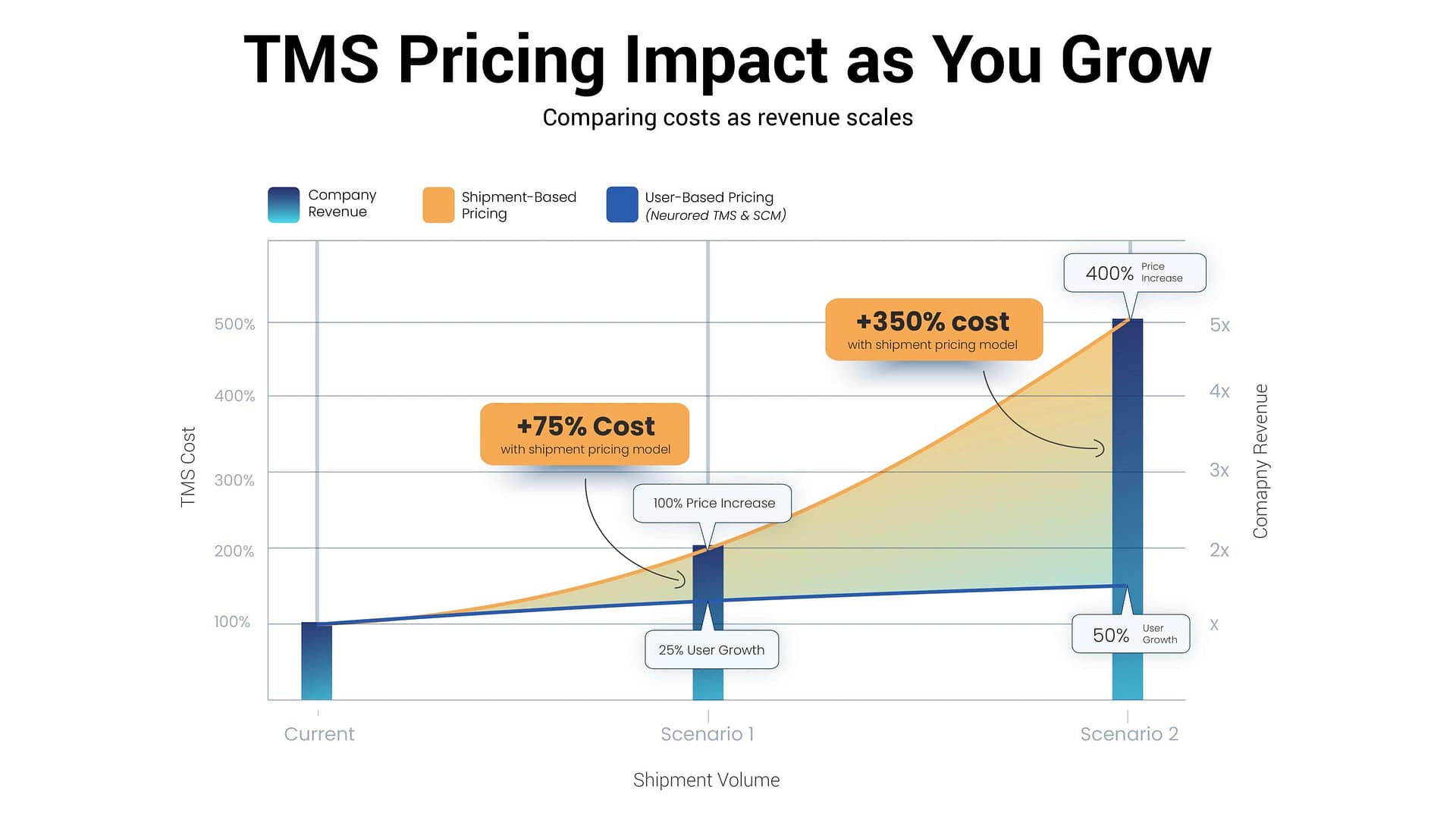
To illustrate the real cost difference, let's compare two growth scenarios: Let's say your shipment volume is directly proportional to your revenue. Doubling your revenue and scaling to 5x. In both cases, we'll show how shipment-based pricing forces costs to rise in lockstep with volume, while user-based pricing captures your efficiency gains.
Here's the math:.
Scenario 1: The Efficiency Milestone (2x Revenue)
When you double your business, you shouldn't double your software bill. Increased operational density means your team doesn't need to double in size.
- Shipment-Pricing Model: Costs rise 100%, erasing efficiency gains.
- User-Pricing Model: Headcount scales just 25% to support the new volume.
- The Win: You avoid 75% of the cost increase demanded by the shipment-pricing model.
Scenario 2: High-Growth Scaling (5x Revenue)
At high volume, the "Shipment-Pricing Tax" becomes a liability. Moving to 5x revenue demonstrates true operational leverage.
- Shipment-Pricing Model: Costs increase by 400%.
- User-Pricing Model: Headcount increases by only 50% due to automation.
- The Win: You avoid 350% of the cost increase compared to the shipment-pricing option.
Shipment-based TMS cost keeps your margins flat, while user-based pricing captures the value of your efficiency.
How User-Based Pricing Model Works
You're charged per user seat, not per shipment. For example, with Neurored TMS & SCM, your software cost grows in predictable steps only when you add people, not every time you process a shipment. To make this simple, your TMS investment breaks down into three parts:
1. User Licenses
Your monthly per-seat subscription covers the core system plus the cloud infrastructure that powers it. This includes automatic updates, security, platform maintenance, and performance. In other words, this is the cost of the digital space your team occupies.
2. Marginal Transaction Costs
These apply only to the activities that genuinely scale with usage, such as tracking events, external API calls, booking requests, and carrier updates. They reflect real variable work performed by the system, making them the software equivalent of electricity.
3. Implementation, Training, and Ongoing Support
This includes custom configuration, workflow design, data migration, UAT, user training, and continuous optimization. It also includes access to a global support team that helps you adapt processes as your business evolves.
The customised implementation is the part many software vendors skip entirely, because their software cannot be adapted to your operational reality. Neurored does the opposite. We align the system with the processes that already work for your business instead of forcing you into rigid templates.
‣ Learn more about how off-the-shelf transportation software may be holding you back
Why A User-Based Pricing Model Supports Growth
Peak season resilience. If you experience a 30% volume surge but handle it with the same staff, through automation or better execution, your software bill stays flat. No penalty for seasonal spikes. No emergency invoice from your vendor.
Spot market competitiveness. The marginal software cost of one extra shipment is zero, so you can bid more aggressively on spot freight. You know your cost floor is lower than competitors on shipment-based pricing.
Productivity investments pay you. Invest in automation that reduces manual data entry? You keep the savings. Train your team to be faster? You keep the savings. Build smarter workflows? You keep the savings.
In shipment-based pricing, those investments just let you process more volume at a growing cost, enriching your vendor. In user-based pricing, they let you process more volume with the same TMS costs, enriching you.
Which TMS Pricing Model Should You Choose?
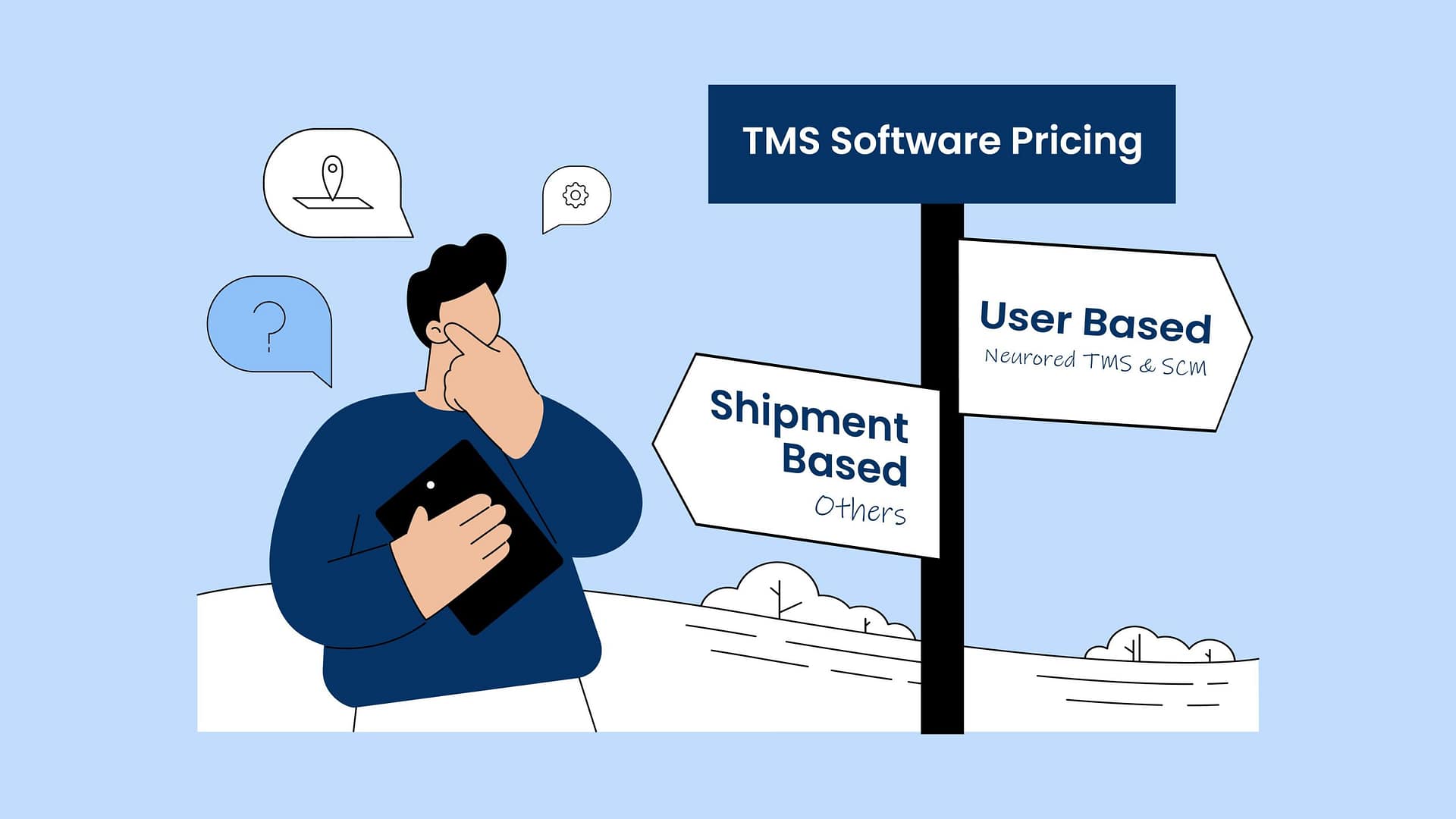
Here's the simple version: if you're planning to grow, user-based pricing is your only serious option.
Shipment-based pricing is a structural penalty on success. The faster you grow, the more you pay. User-based pricing gives you leverage. Every efficiency gain makes you structurally more profitable.
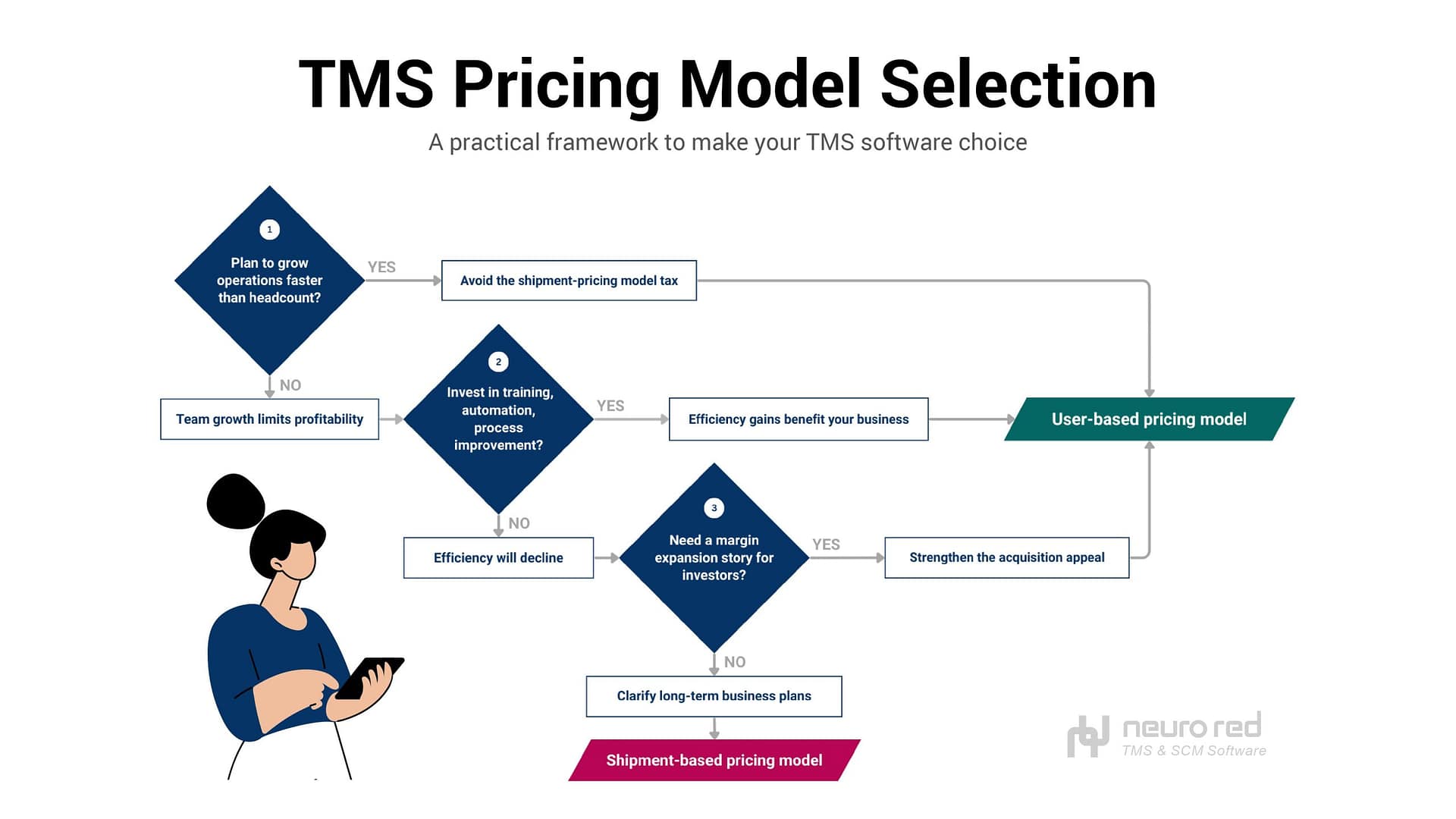
Choose user-based if:
- You're targeting 20%+ annual volume growth
- You're raising capital or preparing for acquisition
- You invest in operations improvement
- You want to tell a margin expansion story
Which describes everyone who cares about building value.
The One Exception (And Why You Should Be Skeptical of It)
- Small niche forwarders (1,000-3,000 shipments, low single-digit growth)
- Family businesses not seeking exit
- Mature, low-growth markets
TMS Software Pricing Model Selection Framework
Other Considerations for Buying a TMS Software
Most teams start their TMS search focused on capabilities: "Does it automate our workflows?" "Can it manage multimodal freight?" "Will it connect to our existing systems?"
These questions matter.
But here's a question that might matter more: Will this platform support our business three years from now, when our operations look different than they do today?
That's where foundations make the difference.
Because many TMS solutions are built as self-contained systems. Which can mean:
- Customization requires going back to the vendor
- New integrations depend on what's already been built
- Scaling with your business takes significant effort
When a TMS runs on an established enterprise platform, like Neurored TMS & SCM does with Salesforce, you unlock capabilities that standalone systems can't match:
- Customization You Control Directly: Configure processes around your actual operations without waiting on vendor updates
- Integrations That Expand With Your Needs: Connect to Salesforce's ecosystem of 7,000+ business applications and any API-enabled system.
- Scaling That Happens Naturally: Infrastructure built to grow from small teams to global enterprises without architectural changes.
All this happens with security that's enterprise-ready and proven to be ISO, GDPR, and SOC2 compliant.
‣ Learn more about aligning your TMS choice with business strategy
Unlock Growth with User-Based TMS Pricing
The math is simple. Shipment-based pricing taxes efficiency. User-based pricing rewards it.
Every process improvement you make, every automation you build, every hour you invest training your team. Under shipment-based pricing, the transportation management system cost doubles because shipment count doubled. Cost per shipment stays flat. Under user-based pricing, you keep it.
This isn't a close call. It's not a "depends on your business" situation. If you're planning to grow, user-based pricing is the only serious option. Shipment-based pricing is a structural ceiling on your economics disguised as predictable billing.
Your competitor on user-based pricing can bid more aggressively on spot freight because their marginal software cost is zero. They can invest in automation knowing the savings flow to their margin, not their vendor's revenue. They can tell investors a margin expansion story while you're explaining why software costs grew faster than revenue.
The choice isn't whether you'll pay for software, you will. The choice is whether you'll pay for a model that makes you stronger as you scale, or one that extracts value every time you improve.
Neurored TMS & SCM runs on user-based pricing because we believe logistics companies should capture the upside of their operational excellence. Built natively on Salesforce, it scales with your team, not your transaction volume, turning efficiency gains into margin expansion instead of vendor enrichment.
If you want software that works for you instead of against you, book a demo.
Schedule your demo today!

Ricardo Medem
Share Article



Let’s Get Started
Schedule a Demo Now