
Can Mid-Sized Forwarders Compete with Global Giants?
Consolidation is reshaping freight forwarding. Each acquisition shifts more contracts and more leverage into the hands of a few global giants. Their scale lets them cut rates, promise coverage everywhere, and negotiate from a position of strength.
For mid-sized forwarders, this reality is hard to ignore. Competing head-on with giants can feel impossible. Yet history shows that markets rarely belong entirely to the biggest players. There is room for those who know where to stand and how to move.
The real question is not whether mid-sized forwarders can survive in the shadow of giants. It is how they can use that position to compete differently, and in doing so, grow stronger.
The Market Reality: Giants on the Move

Consolidation has shifted the balance of power. Carriers are tying up contracts with fewer and bigger forwarders. Customers are attracted to “one-stop-shop” offerings, even if it means giving more leverage to global players.
We saw this when two of the world’s largest forwarders merged and immediately secured better carrier terms than any regional competitor could dream of. Within weeks, mid-sized players in those same lanes were forced to explain to customers why their rates suddenly looked less attractive.
The boardroom question is a sobering one: are we destined to be squeezed out, or do we have defensible ground?
The Paths to Compete
For mid-sized forwarders, three strategic orientations tend to emerge. Each carries risks, but each can be made viable with the right systems and clarity of execution.
1. Niche Specialization
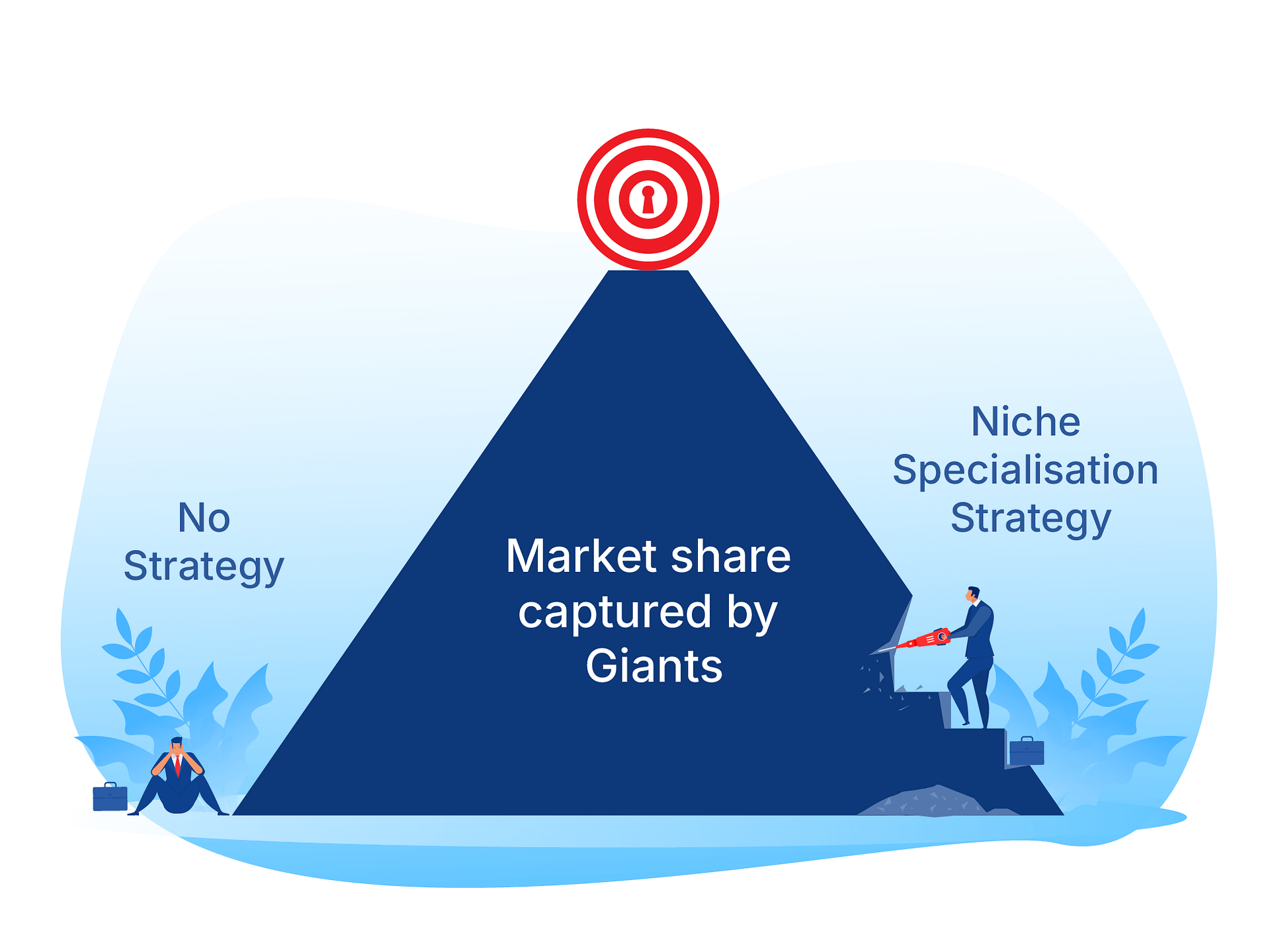
Global giants win on volume, but they cannot replicate deep expertise everywhere at once.
A mid-sized forwarder that focuses on a vertical like pharma or perishables, or that builds dominance on high-value trade lanes, can defend margins where expertise matters more than scale. Cold-chain reliability, tailored handling, or specialized regulatory knowledge are not things that can be copied overnight.
The challenge is proving that expertise, not just claiming it. This is where digital tools change the game. With CRM and SRM systems, you can manage specialist networks and keep track of every certification, compliance step, and customer requirement. With supply chain visibility portals, you can show customers real-time performance and historical service reliability.
Specialization is no longer just a claim in a sales deck. It becomes a transparent, measurable advantage.
2. Alliances and Partnerships

Not every forwarder wants to go niche, and not every customer needs niche services. Another option is to pool resources with regional players, 3PLs, or technology platforms.
A mid-sized forwarder in Latin America recently did this by building partnerships across Europe and Asia, creating a virtual global network. To the customer, the service looked seamless. Behind the scenes, Collaboration Portals and system integrations made sure partners worked from the same data.
The key question for leadership is not “Can we find partners?” It is “Which partnerships amplify our strengths without diluting our brand?” The right alliances create reach and credibility without sacrificing independence.
3. Competing on Agility

Scale has its strengths, but it also slows you down. Giants move through layers of approval, legacy systems, and standardized playbooks. Mid-sized forwarders can turn this weakness into an advantage.
When rates shift suddenly, or a lane gets disrupted, smaller forwarders with agile systems can pivot pricing, reroute volumes, and configure operations in days, not months. Giants cannot reconfigure that quickly without weeks of red tape.
This agility is not just instinct; it needs to be backed up by tools. Transportation & Logistics Optimization Software enables dynamic capacity balancing, optimization algorithms, and what-if scenario planning so mid-sized forwarders can adapt fast and prove reliability when customers are most vulnerable.
In a market that punishes delay, speed is more than a virtue. It is a competitive weapon.
Digitization: The Equalizer
The strategies above are not new. What makes them realistic today is digitization. Technology closes the gap between mid-sized forwarders and global giants.
Data as a Level Playing Field

Giants can afford armies of analysts. Mid-sized forwarders cannot. But the right dashboards can give you the same clarity with fewer people.
With Neurored’s Freight Forwarding Software, leaders can see profitability by customer, lane, or shipment, anticipate bottlenecks, and act on prescriptive insights. Decisions no longer depend on gut feel or scattered spreadsheets. They are backed by the same kind of intelligence giants rely on, scaled to fit your team.
Customer Experience at Scale

For many shippers, the real differentiator is not the cheapest rate, but the confidence that comes from reliable service.
Supply Chain Visibility tools, branded customer portals, and proactive exception alerts allow mid-sized forwarders to deliver “giant-level” customer experience without giant-level overhead. A customer logging in to check their shipments and receiving proactive updates sees no gap between your service and that of a multinational. In fact, they may prefer the personal service you can layer on top.
Cost Control Through Automation

Margins are always under pressure, and giants can afford to ride out thin returns. Mid-sized players cannot. Efficiency is not optional.
Automated processes & AI-assisted systems for Back Office tasks like invoicing, compliance, and documentation remove manual errors and free up staff to focus on customer-facing work. These gains are not about cutting costs for the sake of it. They are about protecting the margin that lets you compete.
Always-On Infrastructure

Reliability is one of the strongest selling points of the giants. Customers assume bigger means safer. But with the right backbone, mid-sized players can match them.
Neurored’s TMS Software is built on Salesforce and AWS, with enterprise-grade security and global scalability. That means uptime, compliance, and resilience are baked in. Deep integration with ERP, WMS, and CRM systems ensures coherence even when volumes spike or markets shift.
Reliability is not just an IT promise. It is a commercial advantage, because it assures customers you will be there when it matters.
Conclusion: Turning Strengths Into Scale

Mid-sized forwarders do not need to mimic global giants to survive. They need to choose a clear path.
Specialize in niches where expertise beats volume. Build alliances that extend reach without erasing identity. Compete on agility where giants are too slow to move.
Each path can succeed, but only when backed by digital systems that make the strategy sustainable. That is where the real equalizer lies.
The giants may own scale today. But speed, expertise, and customer trust are not just defensive shields. They are engines of growth. They can become the very foundation of scale; the kind built on loyalty and resilience, not just mergers and acquisitions.
The question is not whether you can compete with global giants. The real question is whether you are ready to get started with a Freight Forwarding Software that can propel your growth.
Schedule your demo today!

Ricardo Medem
Share Article



Let’s Get Started
Schedule a Demo Now